
Industrial Flooring: Types, Applications, and How to Choose the Right Solution
Ask any site engineer which part of a factory gives the most trouble after handover, and many will point to the floor. Problems with industrial flooring can affect daily operations and lead to costly repairs.
Choosing the right flooring depends on the work carried out in the facility. The floor must be able to handle the loads and wheel traffic, withstand any chemicals or materials that may spill on it, and suit the temperature conditions in the area. The time available for installation also matters, especially when the work requires production to stop.
Let’s look at the different types of industrial flooring, their applications, and how to choose the right system for your facility.
What is industrial flooring?
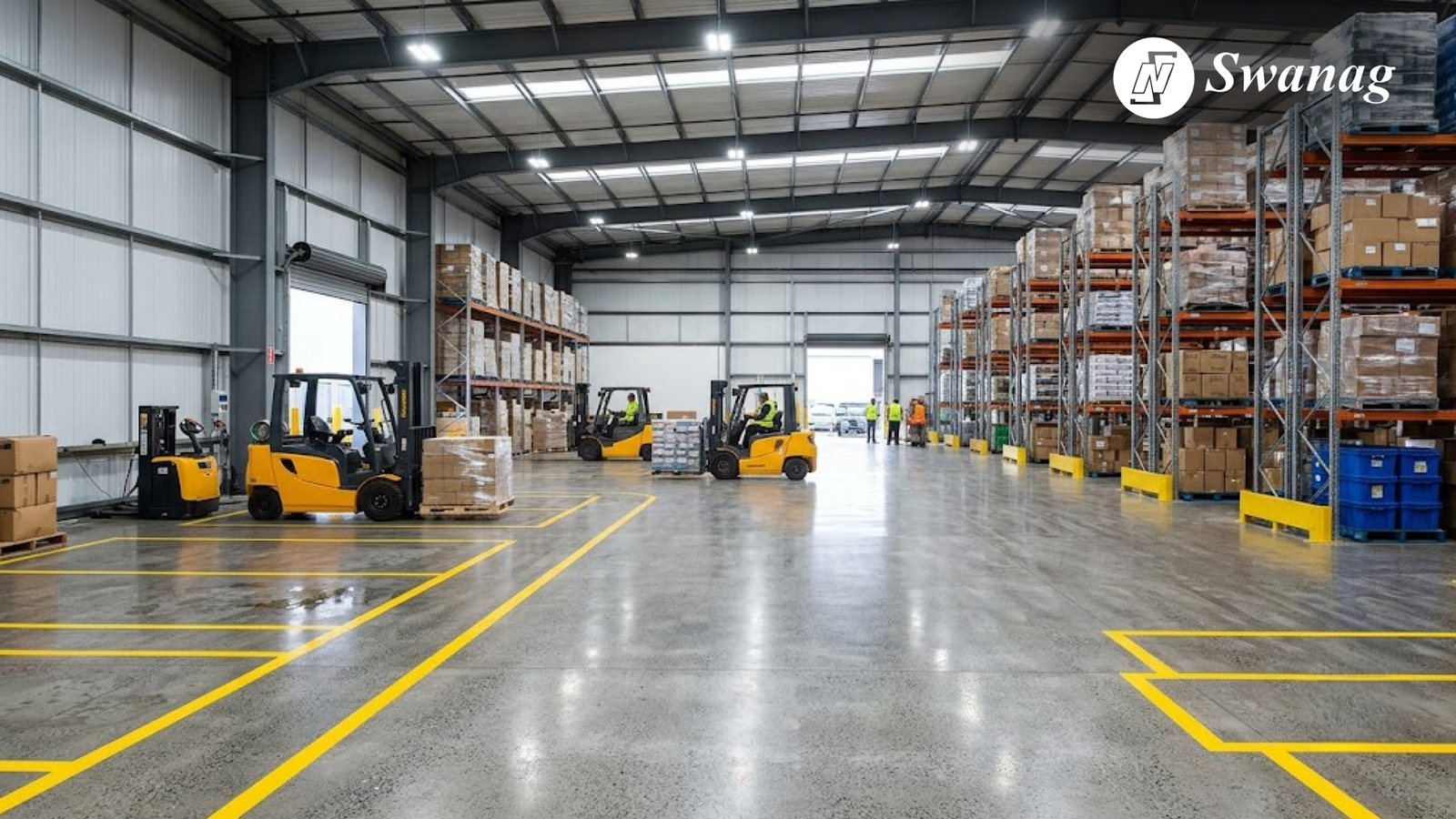
Industrial flooring is used in factories, warehouses and other work areas where the floor has to handle heavy loads, forklifts and machinery. Depending on the work, it may also need to withstand oil, chemicals, water and regular hot-water washing.
You will commonly find these floors in manufacturing plants, warehouses, cold storage units, dairies and workshops.
What Are the Main Types of Industrial Flooring?
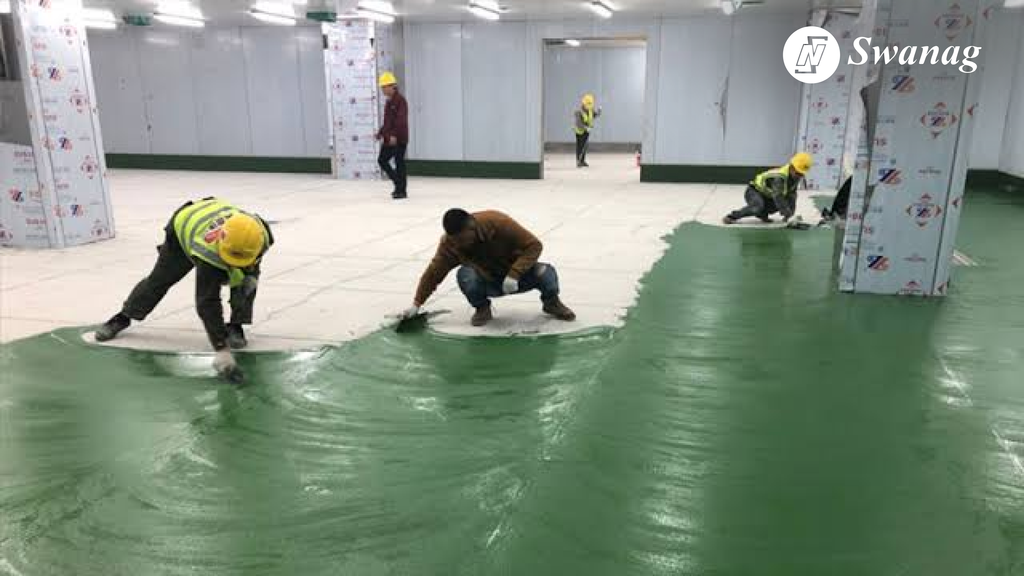
Different flooring systems serve different purposes. The choice depends on traffic, chemical exposure, temperature, hygiene requirements and the time available for installation.
| Flooring system | Typical applications | Indicative thickness or specification | Indicative cost (₹/sq ft) | Main limitation |
| Hardener-topped concrete | Warehouses, heavy-traffic areas | 150–200 mm slab may be used; hardener dosage often 3–5 kg/m² | ₹50–₹110 | Limited resistance to some chemicals; wet surfaces can be slippery |
| Thin epoxy coating | Workshops, packing areas, light-duty zones | Around 200–300 microns | ₹40–₹80 | Not suitable for heavy traffic or significant slab movement |
| Self-levelling epoxy | Assembly areas, laboratories, selected vehicle zones | Around 2–3 mm | ₹90–₹180 | Requires a sound, suitably dry concrete base |
| PU cementitious screed | Food plants, dairies, breweries, cold storage | Around 6–9 mm | ₹180–₹350 | Higher cost; needs experienced application |
| Polyaspartic coating | Areas requiring rapid return to service and UV stability | Commonly around 0.5–2 mm, depending on system | ₹100–₹220 | Short working time; not all systems suit heavy impact |
| MMA flooring | Rapid repairs, freezers and short shutdowns | Around 2–4 mm | ₹200–₹400 | Strong odour during application and higher cost |
| Vinyl ester lining | Chemical processing and selected acid-resistant areas | Around 2–5 mm, depending on system | ₹200–₹450 | Must be selected for the exact chemicals and conditions |
| ESD flooring | Electronics assembly, selected static-control areas | Around 2–3 mm, depending on system | ₹150–₹350 | Requires electrical testing and suitable grounding |
| Resin screed or heavy topping | Loading bays, press shops, steel fabrication | Around 6 mm and above | ₹200–₹400 | Higher cost and demanding substrate preparation |
Note: These are broad budgeting estimates, not current supplier quotations. Actual rates vary with location, project size, surface preparation, material brand, specification and application conditions. Confirm rates and performance requirements with the manufacturer and contractor.
1. Concrete Flooring With a Hardener
Concrete flooring with a surface hardener is common in warehouses and manufacturing plants because it can handle substantial traffic when properly designed and constructed. The concrete slab provides the load-bearing capacity, while the hardener improves resistance to surface wear.
Several terms are used for concrete floor construction, but they do not mean the same thing. VDF, or vacuum dewatering flooring, involves removing excess water from freshly placed concrete using a vacuum process. Power floating is a mechanical finishing operation. A dry-shake hardener is a material applied to fresh concrete and worked into the surface to improve its wear resistance. These methods may be used together, depending on the specification.
Warehouse slabs may be around 150–200 mm thick, but this is only a starting reference. Heavier racking, container handling, narrow-aisle trucks and concentrated machinery loads may require a different design. The structural engineer should determine slab thickness, concrete grade, reinforcement and joint layout using actual load information and site conditions.
Sub-base preparation and curing are equally important. Joints must be cut at the right time and in the locations specified in the slab design. If joint cutting is delayed, uncontrolled cracks may develop. Poor curing can also lead to surface dusting, cracking and reduced durability.
Where forklifts operate in narrow aisles or at significant lifting heights, floor flatness and levelness become important design requirements. These should be agreed before concreting, using a suitable specification such as ASTM E1155 or the relevant Concrete Society TR34 guidance.
2. Epoxy Flooring
Epoxy flooring is widely used in workshops, assembly areas, laboratories and packing zones. It forms a smooth, seamless surface that is relatively easy to clean and can provide resistance to selected oils and chemicals.
The important point is that epoxy comes in different system thicknesses. A thin coating of around 200–300 microns is intended mainly for light-duty use. A self-levelling system of around 2–3 mm can provide a more substantial finish, provided the concrete base is suitable and the system is specified for the expected traffic.
Epoxy is rigid. If the concrete cracks or moves, the coating may crack over the same line unless the joint or crack is treated according to the system design. Standard epoxy can also discolour under prolonged UV exposure.
Putting a thin epoxy coating in a busy forklift lane is a common mistake. The surface may look good at handover, but wheel traffic can wear it down or cause peeling if the coating is not designed for that duty.
3. Polyurethane Cementitious Flooring
Polyurethane cementitious flooring, often called PU cement flooring or urethane cement, is used in food processing plants, dairies, breweries and other facilities exposed to hot water, steam or temperature changes.
Unlike a thin polyurethane paint, this is a thicker cementitious screed modified with polyurethane. It is designed for demanding environments where thermal shock, cleaning routines and chemical exposure must be considered together.
Typical thicknesses are around 6–9 mm, although the correct specification depends on the system and service conditions. It generally costs more than a standard epoxy coating, but it may be more suitable where hot-water washing or temperature changes would damage a less suitable finish.
Application conditions matter. The contractor must follow the manufacturer’s requirements for substrate preparation, moisture, temperature, mixing and curing. A team experienced only in thin epoxy coatings may not have the skills needed for this type of installation.
4. Polyaspartic Flooring
Polyaspartic coatings are used where quick curing and UV stability are important. Depending on the system, the floor may return to foot traffic within a few hours, helping reduce downtime.
They can be useful in areas exposed to daylight and may be used as a topcoat over another compatible resin system. However, the curing speed also creates a challenge. The material has a limited working time, so the application team must plan mixing, spreading and finishing carefully.
Polyaspartic is not automatically suitable for every heavy-duty industrial floor. The complete system must be selected according to traffic, impact, chemical exposure and the manufacturer’s performance data.
5. MMA Flooring
Methyl methacrylate (MMA) flooring is known for its rapid curing. Some systems can return to service within hours, and certain formulations can be installed at low temperatures.
This makes MMA useful for selected freezer areas, urgent repairs and facilities where a long shutdown is not possible. However, the material can produce a strong odour during application. Ventilation, access restrictions and worker communication must be planned before work begins.
The contractor should confirm the specified system’s curing time, installation temperature and return-to-service conditions rather than relying on a general estimate.
6. Vinyl Ester and Chemical-Resistant Linings
Chemical-resistant linings are used in battery rooms, effluent treatment plants, chemical processing areas and other locations where concrete may be exposed to aggressive substances.
The selection must be based on the exact chemical, its concentration, temperature and duration of contact. A lining that resists one acid may not perform well against another chemical or a mixture of substances.
Before finalising the system, obtain the manufacturer’s chemical resistance data for the actual operating conditions. Where the exposure is particularly demanding, the project team may also consider an appropriate compatibility test. The term chemical-resistant flooring alone is not a sufficient specification.
7. ESD and Conductive Flooring
Electrostatic discharge (ESD) flooring is used in electronics manufacturing, assembly areas and other locations where static electricity needs to be controlled. Conductive flooring may also be required in certain hazardous environments, subject to the site’s safety assessment and applicable requirements.
The flooring system must work as part of a complete static-control arrangement. Material selection, grounding, installation and resistance testing all matter. A visual inspection cannot confirm whether the floor meets its electrical requirements.
Conductive and static-dissipative flooring have different resistance ranges. The correct limits depend on the application and the standard specified for the facility. The contractor should provide test results after installation and confirm that the completed floor meets the project’s requirements.
Where flammable vapours are present, flooring must be specified as part of the site’s wider hazardous-area and static-control assessment. The plant safety team should be involved in the decision.
8. Resin Screeds and Heavy-Duty Toppings
Loading bays, steel fabrication areas, press shops and similar locations may experience impact, dragging loads and concentrated wheel loads. A thin resin coating may not be enough for these conditions.
Resin screeds and heavy-duty toppings use thicker material, often incorporating graded aggregates or quartz. They can provide a more substantial wearing surface when the system is designed for the actual operating conditions.
Thickness alone does not guarantee performance. The concrete base, bond strength, joint details, impact exposure and installation quality must all be considered before selecting a system.
Where Is Industrial Flooring Used?
The work carried out in each area determines which flooring system is suitable. The following examples are a starting point for selection, not fixed specifications.
| Facility or area | Systems commonly considered | What needs attention |
| Warehouses and distribution centres | Hardener-topped concrete | Joint cutting, flatness, levelness and wheel traffic |
| Automotive and engineering plants | Hardener-topped concrete, epoxy or heavy-duty toppings | Oil exposure, machine loads and different requirements across production zones |
| Food plants and dairies | PU cementitious screed | Drainage falls, hot-water washing, coving and cleaning chemicals |
| Pharmaceutical units and laboratories | Epoxy or another suitable seamless system | Hygiene, chemical exposure and wall-floor junctions |
| Cold storage | PU screed or a suitable rapid-curing system | Insulation, vapour control, temperature and slab design |
| Chemical plants and effluent treatment plants | Vinyl ester or another chemically compatible lining | Exact chemical list, concentration and operating temperature |
| Electronics manufacturing | ESD or conductive flooring, as specified | Grounding, resistance requirements and post-installation testing |
| Loading bays and truck areas | Heavy-duty concrete, resin screed or topping | Joint edges, braking forces, turning loads and impact |
How Do You Choose the Right Industrial Flooring?
Before selecting a system, look at how the floor will be used every day. The points below help narrow down the options.
What loads and wheels will the floor handle?
Forklift weight is only one part of the calculation. Wheel material, contact area, turning movements and repeated braking also affect wear. Hard wheels and concentrated loads can be more demanding on the surface than pneumatic tyres.
Check the loads from machinery, storage racks and equipment as well. The slab must be designed for these loads; a surface coating cannot compensate for an inadequately designed concrete base.
What could spill on the floor?
Prepare a list of all substances that may contact the floor, including oils, fuels, process chemicals and cleaning agents. Check their concentrations and temperatures where relevant.
Do not assume that a coating is suitable simply because it is described as chemical-resistant. Confirm compatibility with the manufacturer.
How hot or cold does the area get?
Food processing areas may experience hot-water washing or steam, while cold storage facilities operate at low temperatures. These conditions affect both the concrete base and the surface finish.
PU cementitious screeds are often considered for thermal-shock conditions. Other systems may be suitable depending on the temperature range and operating routine. The specification should reflect the actual conditions rather than the general category of the facility.
Is there moisture in the concrete slab?
Moisture is an important consideration before applying resin coatings. Excess moisture or moisture vapour movement can contribute to blistering, loss of adhesion and peeling.
The slab’s age alone does not establish whether it is ready for coating. Moisture testing should be carried out using a method accepted by the selected flooring manufacturer. Depending on the system, this may include in-slab relative humidity testing or another specified method. A plastic sheet test can indicate possible moisture concerns, but it does not replace quantitative testing where that is required.
Follow the manufacturer’s limits for moisture and surface preparation before application.
How long can the area remain closed?
Installation and curing time can affect production schedules. Standard resin systems may require several days before they can take full service loads, while rapid-curing systems such as MMA may allow a quicker return to service.
Actual times depend on the product, temperature, thickness and site conditions. Confirm when the floor can accept foot traffic, wheeled traffic and full operating loads. If the shutdown window is short, the contractor may need to divide the work into phases.
Are there hygiene requirements?
Food, pharmaceutical and other hygiene-sensitive facilities may need a seamless finish, suitable drainage and coved wall-floor junctions. The design should also account for cleaning methods, chemical exposure and areas where water can collect.
These details should be included in the flooring specification before work starts, rather than left until installation.
What is the total cost?
The rate per square foot is only one part of the cost. Surface preparation, crack repairs, joint work, moisture treatment, application, downtime and future maintenance can all affect the final amount.
A cheaper coating may not be economical if it is unsuitable for the traffic or operating conditions. Compare quotations on the same specification, including thickness, preparation, testing, warranty and return-to-service requirements.
How Do You Maintain an Industrial Floor?
Regular maintenance helps identify damage before it affects operations.
- Clean oil and chemical spills promptly using suitable cleaning procedures.
- Use cleaning equipment and chemicals approved for the flooring system.
- Inspect joints, edges and high-traffic areas periodically.
- Avoid dragging heavy steel components or pallets across the surface where this could cause damage.
- Repair local defects before they spread.
- Renew a sealer or topcoat when inspection shows it is needed and the system permits it.
Maintenance requirements vary between concrete floors, resin coatings and specialised screeds. Follow the manufacturer’s instructions and the facility’s operating procedures.
What Industrial Flooring Mistakes Should Be Avoided?
Some common mistakes can be avoided during planning and installation:
- Selecting a system based mainly on colour or the lowest quotation.
- Skipping moisture or substrate checks when they are required.
- Choosing a thin coating for heavy forklift or impact exposure.
- Ignoring future machinery, storage or production changes.
- Hiring a contractor without relevant industrial flooring experience.
- Failing to coordinate joints and crack treatment with the flooring system.
- Allowing production schedules to compromise preparation or curing.
- Accepting the floor without the required inspection and test reports.
Planning a New Industrial Floor or Repair?
No single industrial flooring system suits every facility. Loads, wheel traffic, chemicals, temperature, hygiene requirements and shutdown time all influence the decision.
Start by documenting the operating conditions and inspecting the existing slab. Then obtain a system recommendation from an experienced industrial flooring contractor and compare quotations against the same technical requirements.
The aim is not simply to install a floor that looks good at handover. It is to select a system that can perform under the actual working conditions and remain maintainable throughout its service life.
Frequently Asked Questions
Hardener-topped concrete is commonly used in warehouses because it can withstand heavy traffic when the slab, surface finish and joints are properly designed. Resin coatings may be considered where additional chemical resistance, dust control or a particular surface finish is required.
Service life varies by system, traffic, substrate condition, installation quality and maintenance. A well-designed concrete floor can serve for many years, while resin coatings may need repairs or renewal sooner. Poor preparation or unsuitable operating conditions can lead to early failure.
Epoxy is commonly used in workshops, laboratories and other general industrial areas. PU cementitious flooring is often considered where hot-water washing, temperature changes or thermal shock are important. The choice depends on the operating conditions and the specific products being compared.
Yes, provided the existing concrete is suitable for the selected system. The contractor must check its strength, moisture condition, contamination, cracks and surface profile. Weak or damaged areas may need repair before the new flooring is applied.
The duration depends on the system, floor area, preparation work and site conditions. Standard resin coatings may need several days before full service, while some MMA systems cure much faster. Confirm the installation schedule and return-to-service requirements with the manufacturer.
Industrial flooring costs depend on the material, thickness, floor area, substrate condition and preparation requirements. Obtain a site inspection and a written quotation that clearly states the system specification, surface preparation, testing and curing requirements.
Some MMA systems can cure within hours, while certain polyaspartic systems also allow a rapid return to service. Actual curing and loading times depend on the product and site conditions. The contractor must confirm when the floor can safely return to operation.
Use a moisture-testing method accepted by the flooring manufacturer. In-slab relative humidity testing or other specified methods may be required for resin systems. A plastic sheet test can indicate possible moisture problems, but it should not replace the quantitative test required by the specification.