
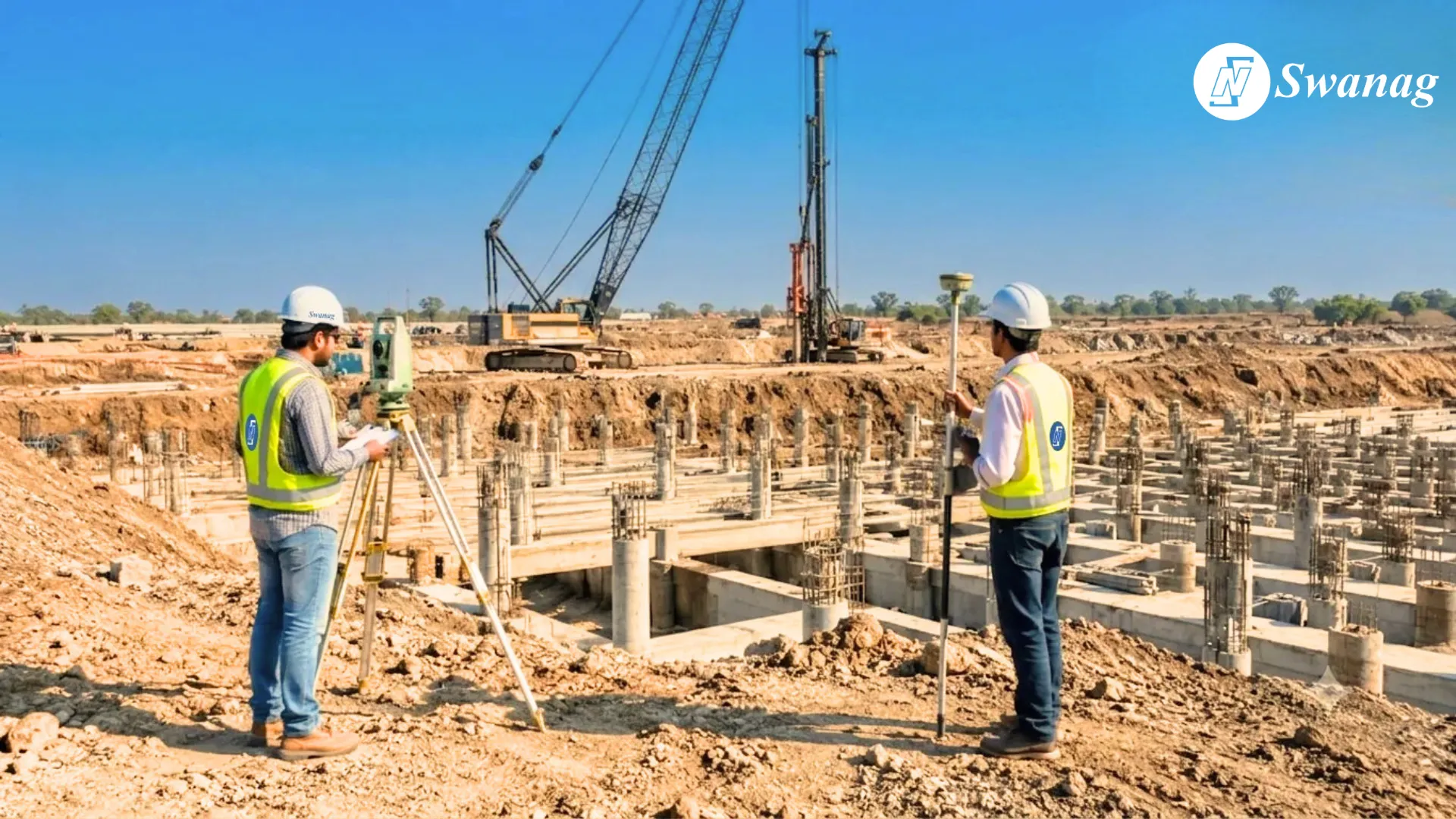
Prestressed concrete plays an important role in modern industrial and infrastructure projects, helping structures handle heavy loads while maintaining long-term stability.
At Swanag Infrastructures, we have worked on a wide range of engineering projects where precision and reliability are critical. One such example is a prestressed concrete application for Century Plyboards (India) Ltd, where structural performance and long-term reliability were key requirements.
Using this project as context, we can better understand how prestressed concrete works and why it is widely used in industrial and infrastructure projects.
What is a Prestressed Concrete?
Prestressed concrete is a form of reinforced concrete in which steel tendons are tensioned before or after casting to introduce controlled internal forces.
These internal forces help the concrete carry loads more efficiently than conventional concrete.
How Prestressed Concrete Works
Prestressed concrete works through a simple balance of two elements:
- Steel tendons are placed under tension
- Concrete resists compression
When these forces are combined, the structure is prepared to handle service loads better. This reduces stress during use and improves overall performance.
Key Benefits of Prestressed Concrete
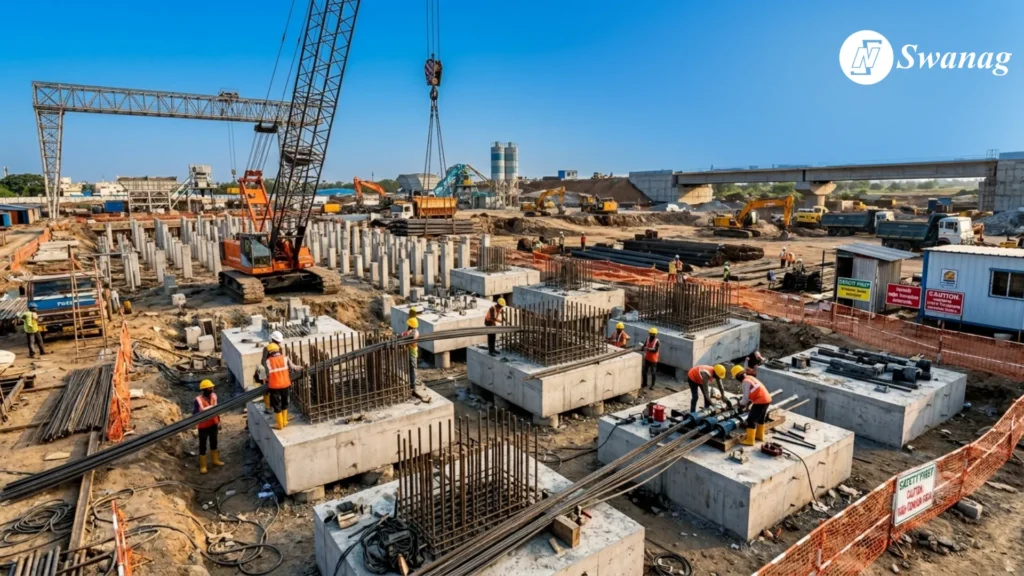
This approach delivers several key benefits:
- Reduces cracking by limiting tensile stress in concrete
- Improves efficiency in how materials are used in structural design
- Performs better under repeated or heavy loading conditions
- Maintains dimensional stability over time
- Allows longer structural spans without the need for intermediate support
Applications of Prestressed Concrete
Prestressed concrete is used where structures need controlled performance rather than just extra strength, including:
- Long-span bridges and viaducts
- Heavy-duty machine foundations designed for industrial loads
- Precast structural components used in construction projects
- Power generation and energy infrastructure facilities
- Industrial setups that require controlled vibration response
Engineering Approach and Execution
Prestressed concrete needs careful step-by-step execution from design to site work.
At Swanag Infrastructures, this includes correct placement of steel tendons, accurate alignment of ducts, and controlled tensioning after concrete casting.
On site, our team focused on precision at every stage of execution. While most projects allow a tolerance of 5 to 10 mm, we consistently achieved near-zero deviation within allowable engineering limits.
This level of accuracy was essential for proper machine installation and long-term structural performance.
Why Prestressed Concrete Matters
Prestressed concrete is used in projects where structures need to perform reliably over long periods, especially when they are carrying heavy or repeated loads. It helps the structure stay steady and predictable over time, which is important in industrial and infrastructure work where small changes can affect how everything performs.
At Swanag Infrastructures, we apply the same focus on precision, planning, and execution to every project we deliver.
FAQ
Prestressed concrete is concrete in which steel tendons are tensioned before or after casting to improve strength, reduce cracking, and increase load-bearing capacity.
It works by combining tensioned steel tendons with concrete in compression, allowing the structure to handle loads more efficiently and remain stable under stress.
Reinforced concrete carries loads after they are applied, while prestressed concrete is pre-tensioned, allowing it to perform better under heavy loads with less cracking and deformation.
It is used in bridges, heavy machine foundations, precast structural systems, power plants, and industrial infrastructure requiring stability and vibration control.
It improves stability under heavy machinery loads, reduces structural movement, and supports precise alignment for long-term equipment performance.
Swanag Infrastructures has executed prestressed concrete works for projects such as Century Plyboards (India) Ltd, focusing on precision, load control, and structural reliability.
Swanag Infrastructures delivered a high-precision prestressed concrete foundation with near-zero deviation, ensuring accurate machine installation and long-term structural performance.