
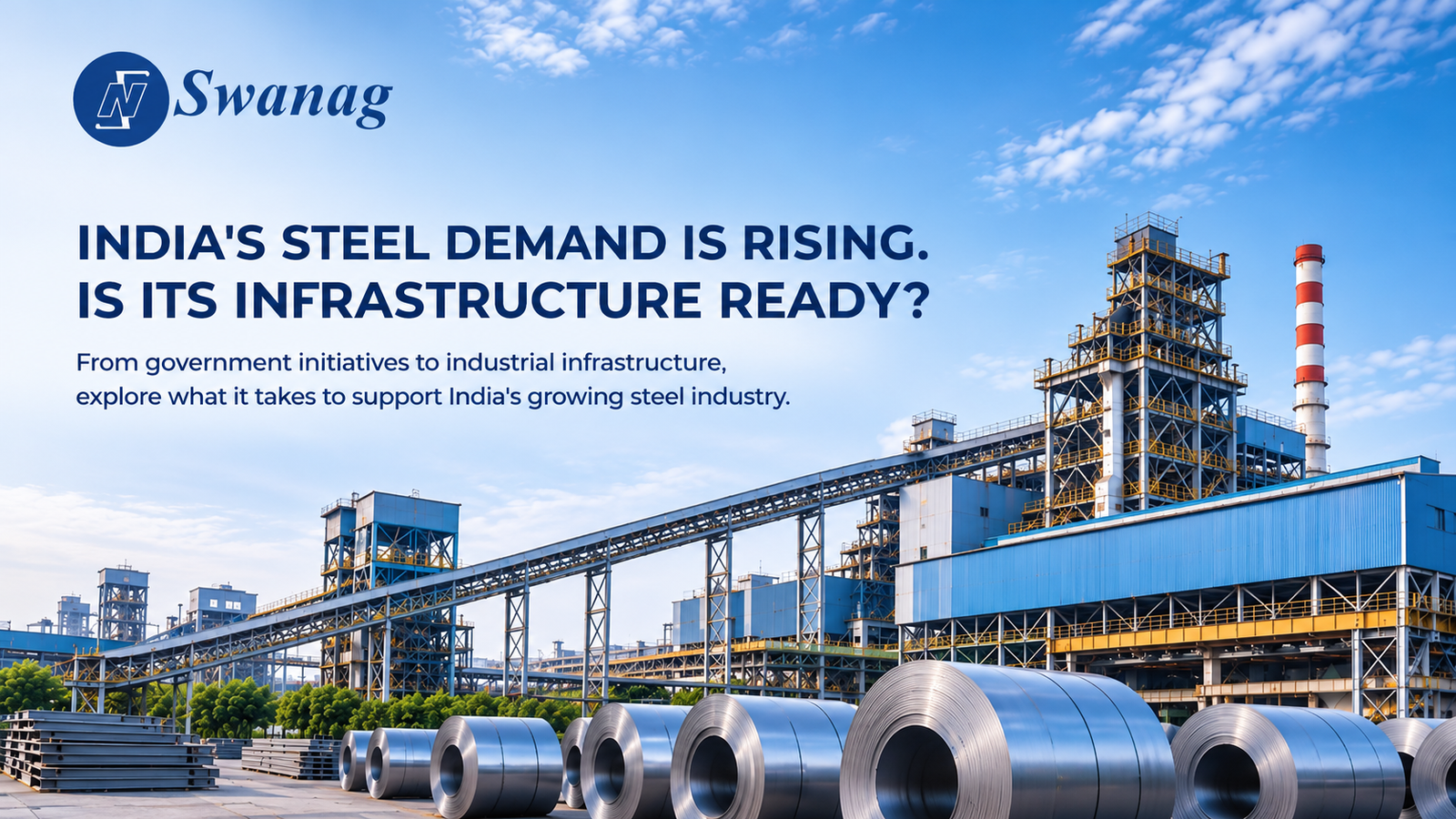
India has been the world’s second-largest crude steel producer since 2018 and is also the world’s second-largest consumer of finished steel. In FY 2025–26, finished steel consumption reached 164.36 million tonnes, more than doubling from 77 million tonnes in 2014–15, according to the Ministry of Steel. The increasing demand for steel across infrastructure, construction, transportation and manufacturing reflects the strengthening of India’s Steel Industry. As these sectors expand, domestic steel producers face the challenge of keeping up with demand.
To support this growth, the government has introduced policies aimed at increasing domestic production, encouraging investment and improving access to raw materials and technology.
Eight Government Policies Supporting India’s Steel Industry Growth
Expanding steel production involves more than increasing manufacturing capacity. Producers also need reliable access to raw materials, improved technology and a dependable market for their products. Several government policies address these requirements.
1. National Steel Policy (2017)
The National Steel Policy provides a long-term roadmap for India’s steel industry. It sets targets of 300 million tonnes of crude steel capacity and 230 million tonnes of finished steel production by 2030–31.
The policy focuses on expanding domestic production, improving technology and reducing dependence on imported steel, particularly high-grade and specialty products.
2. PLI Scheme for Specialty Steel (2021)
India imports certain grades of specialty steel because domestic manufacturers have not always been able to meet demand. The Production Linked Incentive (PLI) Scheme was introduced in 2021 to encourage investment in manufacturing these products within the country.
Under the scheme, selected manufacturers receive incentives linked to eligible production and sales, subject to product categories and scheme conditions. The initiative aims to make domestic specialty steel production more attractive to investors and help manufacturers develop higher-value products.
3. Domestically Manufactured Iron and Steel Products (DMI&SP) Policy
Increasing domestic production also requires a market for Indian-made steel. The DMI&SP Policy addresses this through government procurement.
It gives preference to domestically manufactured iron and steel products in specified government-funded projects and public procurement, subject to minimum domestic content requirements and applicable exemptions under the revised 2025 policy.
4. Steel Quality Control Orders (QCOs)
Increasing production is only part of the challenge. The steel entering the market must also meet established quality standards.
Steel Quality Control Orders make it mandatory for specified products to comply with applicable Indian Standards and obtain the prescribed Bureau of Indian Standards (BIS) certification. This helps prevent substandard products from entering the market and maintains quality requirements across the industry.
5. Steel Scrap Recycling Policy (2019)
Iron ore is not the only raw material used in steel production. Steel scrap is also an important input, particularly for steel manufacturers using scrap-based production processes.
The Steel Scrap Recycling Policy encourages organised scrap collection, scientific dismantling and the development of metal scrapping centres. A better-organised recycling system can improve the availability of domestic scrap and supplement other raw materials used in production.
6. Steel Import Monitoring System (SIMS 2.0)
Imports also influence the domestic steel market. To track these movements more effectively, the government introduced the Steel Import Monitoring System (SIMS).
The upgraded SIMS 2.0 portal was launched on 25 July 2024. It collects information about imported steel products, including their quantities and specifications. This helps the government and industry understand import trends, identify demand patterns and assess where domestic manufacturing capabilities may need to improve.
7. Reduction in Customs Duty on Steel Industry Raw Materials
The cost and availability of raw materials directly affect steel manufacturing. The Union Budget 2024–25 introduced customs duty reductions to ease some of these costs.
Basic Customs Duty on ferro-nickel and specified molybdenum ores and concentrates was reduced from 2.5% to nil. These materials are used in steel manufacturing, and the reduction can help lower input costs for eligible imports.
8. Green Steel Taxonomy (2024)
Steel manufacturing is energy-intensive and can generate significant carbon emissions. As the industry expands, reducing its environmental impact is becoming increasingly important.
To encourage cleaner production, the Ministry of Steel introduced the Green Steel Taxonomy in December 2024. It provides a framework for classifying steel based on carbon emission intensity. Steel produced below the threshold of 2.2 tonnes of CO₂ equivalent per tonne of finished steel can qualify for a green rating, with three-, four- and five-star classifications based on emission levels.
The Infrastructure Needed to Expand Steel Production
Government policies and investment incentives can encourage manufacturers to expand. However, putting that expansion into practice requires suitable industrial facilities.
- Companies planning to increase production must consider whether their existing buildings, foundations and supporting systems can handle the additional load.
- New machinery needs suitable buildings and foundations.
- Raw materials and finished products require adequate storage space.
- Production equipment depends on reliable power, water and other utilities.
When these facilities are not planned together, problems in one area can affect the entire operation.
This is where Engineering, Procurement and Construction (EPC) companies play an important role. An EPC contractor brings together engineering plans, the procurement of materials and equipment, and construction work required to develop a facility. Depending on the project, this could involve building a new plant, expanding an existing factory or upgrading its infrastructure.
Key Infrastructure Requirements in a Steel Manufacturing Facility
Every steel manufacturing facility has its own operational requirements. However, some of the main infrastructure components include:
Production buildings
Large industrial buildings house machinery, production lines and workshops. Their design must account for equipment dimensions, overhead cranes, material movement and access for maintenance.
Machine foundations
Furnaces, rolling mills, compressors and casting equipment place considerable loads on their foundations. These must be designed around the machinery’s weight, operating conditions and ground characteristics to provide the stability required for reliable operation.
Structural steel frameworks
The internal structure of a plant supports machinery, overhead cranes, platforms, pipelines and conveyors. It must accommodate operational loads while leaving enough space for equipment movement, inspection and maintenance.
Warehouses and storage facilities
Steel production involves the movement of raw materials, semi-finished products and finished goods. Warehouses, storage yards and loading areas provide designated spaces for these materials and help organise their movement through the facility.
Utilities and supporting infrastructure
Production equipment depends on reliable electricity, water supply, drainage and industrial pipelines. When production capacity increases, existing utility systems may need to be upgraded or additional facilities installed to meet the plant’s requirements.
All these components need to be considered together from the planning stage. For instance, a building must accommodate the machinery it houses while leaving enough room for material movement and maintenance.
Swanag’s Experience in Steel Industry Infrastructure
The infrastructure requirements of a steel facility depend partly on the type of manufacturing involved. Primary steel manufacturers produce steel from raw materials, while downstream companies process it into plates, sections and other products used in construction, engineering, transportation and manufacturing.
Although their production processes differ, both require factory buildings and supporting infrastructure suited to their operations.
Swanag Infrastructures has worked on factory and office construction projects for companies in these segments. Two projects completed in Sri City, Andhra Pradesh, demonstrate its experience in this area.
Case Study 1: Tohoku Steel India Pvt. Ltd.
In 2018, Swanag completed the factory and office buildings for Tohoku Steel India in Sri City, Andhra Pradesh. Executed for SMCC Construction India Ltd., the project covered 3,820 sq. m. and was completed within six months.
The facility provided space for the company’s manufacturing and administrative activities.
Case Study 2: India Metal One Steel Plate Processing Pvt. Ltd.
In 2019, Swanag partnered with SMCC to complete the factory and office expansion for India Metal One Steel Plate Processing in Sri City. The project covered 5,528 sq. m., had a value of ₹4.43 crore and was completed within six months.
The expansion added factory and office space to support the company’s steel plate processing operations.
Building the Infrastructure Behind India’s Steel Growth
India’s steel industry will need more than increased production capacity to meet its future requirements. It will also depend on the industrial facilities that make higher output possible.
Swanag Infrastructures’ projects for Tohoku Steel India and India Metal One Steel Plate Processing in Sri City reflect its experience in developing this supporting infrastructure.
As India’s Steel Industry grows, the facilities behind that growth will matter just as much as the production targets themselves.
Frequently Asked Questions
Finished steel products are processed steel materials ready for use in construction, manufacturing and other industries. Common examples include TMT bars, wire rods, steel plates, sheets, coils, pipes and structural sections.
Finished steel products are classified as flat and long products. Flat products include steel plates, sheets, strips and coils, while long products include TMT bars, wire rods, beams, angles and channels.
Steel demand in India is increasing due to infrastructure development, construction, transportation and manufacturing. Investments in roads, railways, housing, renewable energy and industrial facilities are creating demand for a wider range of finished steel products.
The Government of India supports domestic steel production through the National Steel Policy 2017, PLI Scheme for Specialty Steel, DMI&SP Policy and Steel Scrap Recycling Policy. These initiatives promote production capacity, specialty steel manufacturing, domestic procurement and scrap recycling.
EPC companies manage the engineering, procurement and construction required to develop industrial facilities. In steel manufacturing, their work can include factory buildings, machine foundations, structural frameworks, warehouses and supporting utilities.
A steel manufacturing plant requires production buildings, machine foundations, structural frameworks, warehouses, storage yards and utility systems. These facilities must accommodate production equipment, material movement, operational loads and maintenance requirements.
Swanag Infrastructures has completed factory and office construction projects for Tohoku Steel India Pvt. Ltd. and India Metal One Steel Plate Processing Pvt. Ltd. in Sri City, Andhra Pradesh. The projects covered 3,820 sq. m. and 5,528 sq. m., respectively, and were completed within six months.