
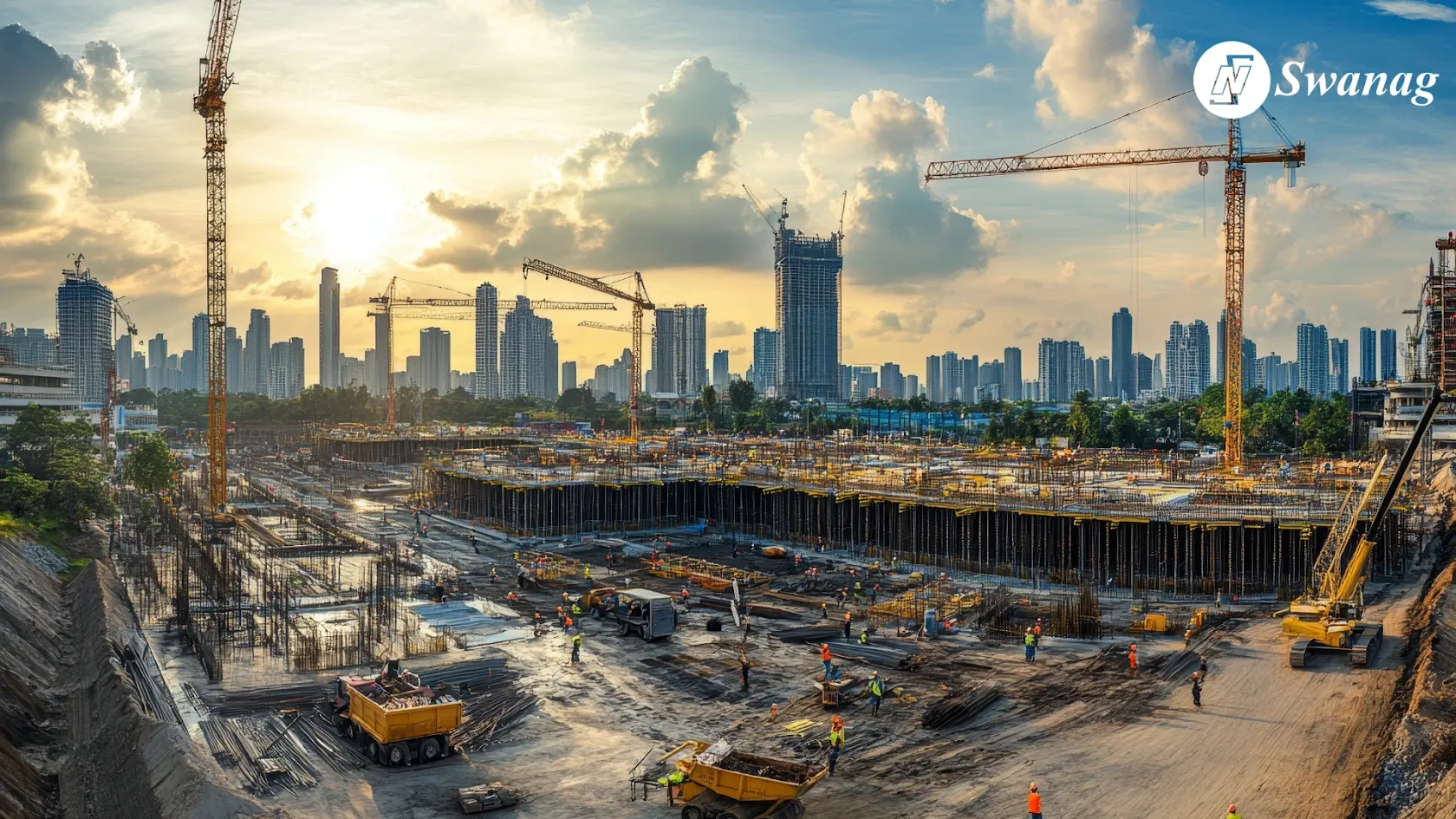
Evolution of Civil Engineering in India
The evolution of civil engineering in India reflects a shift from traditional brick masonry and volume-based construction to scientifically designed reinforced concrete and pre-stressed structures. Over the past sixty years, advances in material science,soil mechanics, structural research, and standardized codes have transformed Indian construction into a modern, technology-driven industry.
As urbanization accelerated and research expanded during the 1970s and 1980s, engineers began to understand the long-term behavior of materials, soil conditions, and structural loads. This knowledge reshaped foundation design, introduced reinforced concrete frame systems, and enabled the construction of taller and more durable buildings. Today, civil engineering in India represents a blend of scientific research, standardized practices, and advanced construction technologies that support rapid urban growth.
What defined the Evolution of Civil Engineering in India before the 1970s
Before the 1970s, civil engineering in India relied largely on traditional construction practices, limited structural research, and minimal use of standardized codes. Most buildings were low-rise and built using brick masonry, shallow foundations, and volume-based material measurements rather than precise engineering methods.
During this period, construction decisions were guided more by experience than by scientific analysis. Load-bearing brick masonry walls formed the primary structural system, and reinforced concrete was used sparingly, mainly for roof slabs or select public infrastructure projects. Foundations were typically strip or stepped types, suitable only for small-scale buildings.
Material proportioning followed fixed ratios such as cement, sand, and aggregate measured by volume. Water content was also estimated visually or by simple measures, which often resulted in inconsistent concrete strength. The lack of widespread structural testing, soil investigation, and code enforcement meant that durability and long-term performance were not fully understood or controlled.
Urban development was slower, land availability was higher, and building demands were modest. As a result, these construction methods were considered sufficient at the time, even though they would later prove inadequate for expanding cities and taller structures.
Why did early limitations impact the Evolution of Civil Engineering in India?

Early construction methods in India faced structural limitations due to inconsistent material quality, lack of soil understanding, and absence of standardized design practices. These gaps often resulted in cracking, uneven settlement, and reduced durability, especially as buildings aged or environmental conditions changed.
As cities expanded and buildings became heavier, the weaknesses of traditional construction became more visible. Structures that performed adequately under light loads began to show distress when subjected to soil movement, moisture variation, and increasing occupancy demands. The core issue was not craftsmanship alone, but the absence of scientific inputs in design and execution.
To explain these limitations clearly, the section is broken down further.
Why did volume-based mixing limit the Evolution of Civil Engineering in India?
Volume-based mixing led to inconsistent concrete quality because material proportions and water content varied from site to site. This caused unpredictable strength, reduced durability, and early deterioration of structural elements.
In earlier construction practices, cement, sand, and aggregates were measured using boxes, baskets, or simple containers rather than by weight. While fixed ratios were followed in theory, variations in aggregate size, moisture content, and compaction significantly altered the final concrete strength. Without laboratory testing or controlled batching, engineers had limited ability to predict long-term performance.
How did clay soil challenges affect the Evolution of Civil Engineering in India?
Clay soils expand when wet and shrink when dry, causing foundations to move unevenly. This repeated movement led to cracks in walls, floors, and structural components over time.
Many residential areas were developed on former agricultural land with high clay content. Seasonal rainfall and drought cycles caused continuous swelling and shrinkage of the soil. Since early foundations were shallow and not designed to accommodate such movement, buildings experienced differential settlement. This problem became widespread during the rapid urban development of the 1970s and 1980s.
Did a lack of structural codes slow the Evolution of Civil Engineering in India?
Without widely adopted structural codes, buildings were designed based on experience rather than verified engineering principles. This limited safety margins and reduced resistance to long-term loads and environmental stress.
Formal design codes for concrete and structural systems were either unavailable or rarely used in early decades. Engineers relied on thumb rules instead of calculated load paths, reinforcement detailing, and durability criteria. As building sizes increased, these assumptions no longer held true, highlighting the urgent need for standardized guidelines and scientific validation.
How did soil science influence the Evolution of Civil Engineering in India?
Soil science transformed foundation design in India by introducing scientific methods to analyze soil behavior and load transfer. This led to the development of specialized foundations that reduced settlement, controlled cracking, and improved long-term structural stability.
As structural failures became more common, engineers began to study soil behavior systematically using principles of soil mechanics. Instead of assuming uniform ground conditions, foundations were now designed based on soil type, moisture variation, and load characteristics. This shift marked the beginning of engineered foundations rather than rule-of-thumb construction.
To understand this transformation, the key developments are explained below.
How did soil mechanics improve the Evolution of Civil Engineering in India?
Soil mechanics enabled engineers to predict how soil would behave under load and environmental changes. This knowledge allowed foundations to be designed to resist settlement, swelling, and shear failure.
Through soil testing and classification, engineers could identify problematic soils such as expansive clay. Parameters like bearing capacity, compressibility, and moisture sensitivity were measured instead of assumed. This scientific approach replaced guesswork with calculation, making foundation performance more reliable across different regions.
Why were under-reamed piles critical to the Evolution of Civil Engineering in India?
Under-reamed piles are deep foundations with enlarged bases designed to anchor buildings in stable soil layers. They were introduced to counteract the effects of expansive clay soils and uneven settlement.
In regions with highly expansive clay, shallow foundations failed repeatedly due to seasonal soil movement. Under-reamed piles provided resistance through their bulb-shaped enlargements, which increased load capacity and uplift resistance. This innovation significantly reduced cracking in residential and public buildings during the late 1970s and 1980s.
How did advanced footings advance the Evolution of Civil Engineering in India?
Raft and isolated footings distributed building loads more evenly across weak or variable soil. These systems minimized differential settlement and improved structural performance.
As buildings grew heavier and soil conditions varied across sites, engineers adopted foundation systems that spread loads rather than concentrating them. Raft foundations acted as a single slab supporting the structure, while isolated footings were carefully sized and positioned based on calculated loads. These methods represented a clear move toward engineered solutions rather than traditional practices.
When Reinforced Concrete Frame Structures Became the Standard
Reinforced concrete frame structures became the standard in India when engineers began using columns, beams, and slabs as the primary load-resisting system. This shift reduced dependence on load-bearing masonry walls and enabled taller, safer, and more flexible building designs.
The transition to reinforced concrete frame construction marked a fundamental change in how buildings were designed and built. Instead of walls carrying structural loads, vertical loads were transferred through columns and beams, while slabs acted as horizontal load-distributing elements. Masonry walls were no longer structural necessities but were used mainly as partitions.
This system allowed greater architectural freedom, including larger spans, open interiors, and increased building heights. It also improved structural behavior under loads by clearly defining load paths and reinforcement detailing. As design knowledge matured and material availability improved, reinforced concrete frames became the dominant construction method for residential, commercial, and institutional buildings across India.
How Government and Private Sectors Shaped Modern Construction in India
Government agencies initially led modern construction in India by executing large infrastructure and housing projects using reinforced concrete. Over time, private developers expanded these practices, driving widespread adoption of high-rise residential and commercial buildings.
In the early stages of modernization, reinforced concrete construction was largely confined to government projects such as public housing, bridges, highways, and institutional buildings. These projects served as testing grounds for new materials, foundation systems, and structural methods. Private participation was limited due to capital constraints and lower demand for high-rise development.
From the mid-1980s onward, rapid population growth and urban expansion created a strong demand for apartments and commercial spaces. Private builders entered the sector in large numbers, adopting reinforced concrete frames and deep foundation systems. This shift accelerated construction activity and extended high-rise development beyond major metropolitan centers into tier-two and tier-three cities.
What Role Pre-Stressed Concrete Plays in Modern Indian Civil Engineering
Pre-stressed concrete plays a critical role in modern Indian civil engineering by allowing structures to span longer distances with greater strength and durability. It reduces cracking, improves load performance, and enables complex architectural and infrastructural designs.
As construction demands increased, conventional reinforced concrete reached practical limits in terms of span length, structural efficiency, and material optimization. Pre-stressed concrete addressed these challenges by introducing controlled compressive forces that counteract tensile stresses under load. This approach significantly enhanced structural performance and service life.
In India, pre-stressed concrete is now widely used in bridges, flyovers, commercial buildings, auditoriums, cinema halls, and large-span roofs. Its adoption reflects the maturity of engineering practices, availability of skilled design expertise, and improved construction quality control. The use of this technology demonstrates how civil engineering in India has progressed from basic structural solutions to advanced, performance-driven systems.
Conclusion: The Evolution of Civil Engineering in India
Civil engineering in India has evolved from experience-based construction to a discipline grounded in scientific research, standardized codes, and advanced structural systems. Over the past six decades, improvements in material science, soil mechanics, and design methodologies have enabled safer foundations, taller buildings, and more durable infrastructure. This transformation reflects not only technological progress but also the growing ability of engineers to respond to urbanization, population growth, and complex construction challenges with precision and reliability.
FAQs
When did reinforced concrete become common in Indian construction?
Reinforced concrete became common in India after the 1970s, when structural research, material availability, and design codes improved and urban construction demands increased.
Why were early buildings in India mostly low-rise structures?
Early buildings were low-rise because construction relied on load-bearing masonry walls and shallow foundations, which limited height and load capacity.
What soil problems most affected construction in India in the past?
Expansive clay soils caused swelling and shrinkage due to moisture changes, leading to uneven settlement and cracking in buildings.
How did private builders change India’s construction industry?
Private builders accelerated apartment and commercial construction after the 1980s, expanding high-rise development beyond government-led projects and metro cities.
Where is pre-stressed concrete commonly used in India today?
Pre-stressed concrete is widely used in bridges, flyovers, large-span buildings, commercial structures, and public infrastructure projects.
