
- Written by: admin
- February 26, 2026
- Categories: Industrial Construction
- Tags:
Pre-Engineered Buildings for Industrial Construction: A Complete Guide for Industrial Projects
Industrial construction today is driven by speed, cost predictability, scalability, and structural efficiency. Businesses cannot afford prolonged construction timelines or repeated design changes once machinery procurement and production planning are underway.
This is where Pre-Engineered Buildings (PEB) have become a preferred solution for industrial construction.
From factories and warehouses to logistics hubs and utility buildings, PEB structures are transforming how industrial facilities are built, expanded, and commissioned.
Let us break this down clearly.
What Are Pre-Engineered Buildings (PEB)?
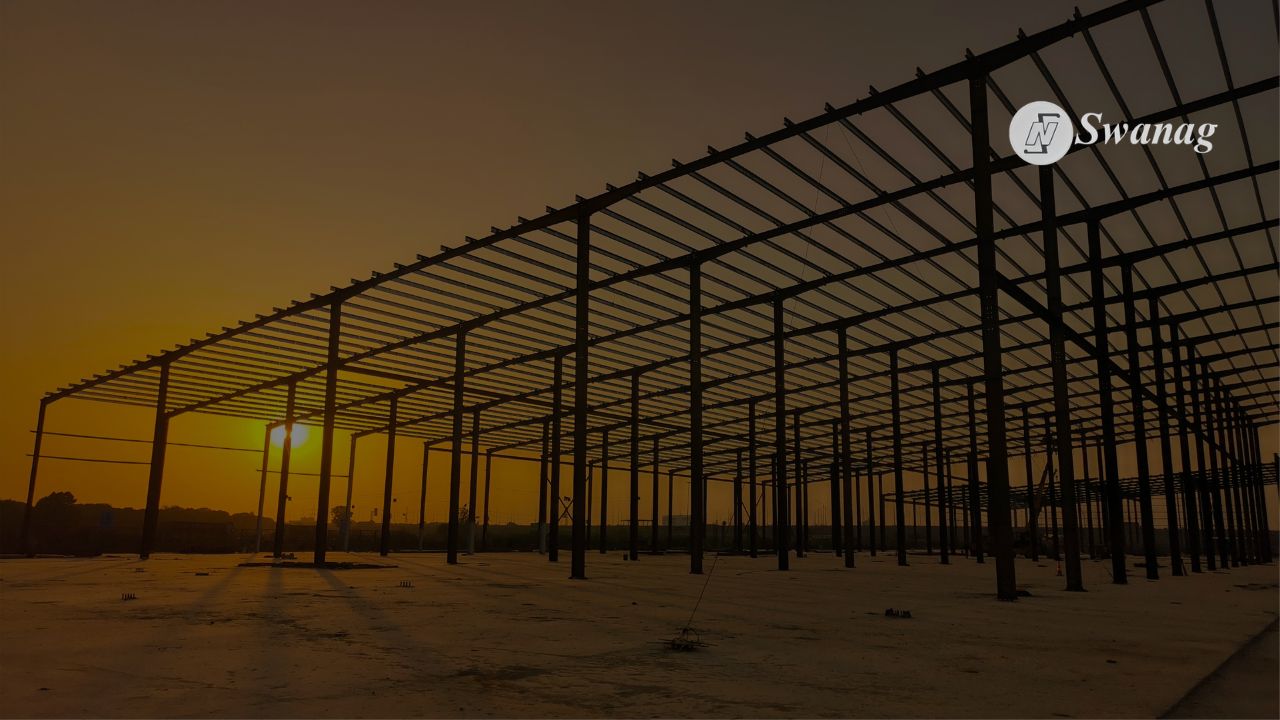
A Pre-Engineered Building is a steel structure that is designed, engineered, and fabricated in a factory-controlled environment before being transported to the site for erection.
Instead of building structural components entirely on-site, PEB systems are:
- Engineered based on load calculations and project requirements
- Fabricated with precision
- Delivered in ready-to-assemble components
- Installed through planned erection sequencing
The structural system typically includes:
- Primary steel frames
- Secondary members (purlins and girts)
- Roof and wall cladding systems
- Bracing systems
- Mezzanine supports where required
Because fabrication happens off-site, on-site activities are faster, cleaner, and more predictable.
Why PEB Is Ideal for Industrial Construction
Industrial buildings are built for output, not aesthetics. Your structure has to support equipment movement, material flow, ventilation needs, utilities routing, and safe maintenance access. That is why Pre-Engineered Buildings (PEB) are widely preferred for factories, warehouses, and logistics facilities. PEB brings an engineered, system-based approach where the primary steel frame and building envelope are designed to work together with predictable performance.
The biggest advantage industrial owners feel is time certainty. PEB allows fabrication and civil works to progress in parallel. While foundations and anchor bolts are executed on site, the steel frame can be fabricated off-site. Once the base is ready, erection becomes a planned activity instead of an open-ended site fabrication exercise.
Where PEB helps industrial timelines most:
- Faster mobilisation and faster structural closure
- Parallel progress: foundations + steel fabrication together
- Quick erection cycles with planned sequencing
- Earlier handover for MEP and internal works
PEB is also ideal for large functional spaces. Industrial layouts often need clear spans for production lines, storage racks, and material handling. A well-designed PEB structure reduces internal obstructions and creates flexible bays that can be adapted as the facility evolves.
Industrial use-cases where clear span matters:
- Warehousing and racking layouts
- Manufacturing floors with equipment movement
- Loading docks, staging bays, and dispatch zones
- Buildings with EOT crane requirements
Finally, industrial projects change and expand. A facility planned today may need additional bays next year. PEB supports phased growth when the structure is designed with expansion in mind.
When Should You Consider PEB?
PEB is not a default for every project. But it is a strong fit when speed, scale, and operational flexibility matter more than heavy architectural complexity.
You should consider Pre-Engineered Buildings when you want faster commissioning and predictable execution.
PEB is ideal for:
- Factories and industrial sheds
- Warehouses and logistics hubs
- Workshops and assembly units
- Cold storage and large storage buildings
- Utility buildings where speed is critical
- Multi-bay buildings with repeated structural grids
How to Choose the Right PEB Contractor
Choosing the right PEB contractor is the real success factor. PEB fails when it is treated as “steel erection only.” In reality, industrial PEB requires tight coordination between civil foundations, anchor bolts, fabrication tolerances, erection sequencing, roofing and cladding integration, and service cut-outs for MEP.
A good contractor will first prove that they understand industrial execution. This is important because industrial sites have stricter safety expectations, live plant constraints, heavier loading requirements, and tighter handover schedules.
What to check first: industrial readiness
- Experience in factories, warehouses, logistics, and industrial expansions
- Ability to plan work around industrial site constraints
- Understanding of crane movement, access control, and safety systems
The next check is the biggest risk point: the civil-to-steel interface. Most delays happen when anchor bolts are wrong, levels mismatch, or base plates do not align. A capable contractor will have clear procedures for bolt templates, surveying, level checks, and sign-offs before steel arrives.
What to verify: civil + PEB interface control
- Anchor bolt setting process and inspection checkpoints
- Surveying and level control methods
- QA checks before dispatch and before erection
- Practical tolerance control on site
Finally, you must check how the contractor handles the “building completion,” not just the “steel completion.” Industrial buildings need cladding, drainage, ventilation elements, planned openings, and coordination for MEP so that commissioning work can start without delays.
What matters for a clean industrial handover
- Roofing, cladding, gutters, down-takes planned properly
- Service openings planned early for MEP and fire systems
- Erection safety and bolt torque checks documented
- Finish quality, leakage prevention, and maintenance access planning
Why Swanag Is a Strong Partner for Industrial PEB Projects
Swanag approaches PEB from an industrial construction perspective. That means we plan the building as a complete execution system, coordinating civil readiness, anchor bolt accuracy, erection sequencing, and envelope completion so the project moves toward commissioning without avoidable corrections.
Why clients consider Swanag for PEB:
- Industrial execution experience with schedule-driven planning
- Strong coordination between civil works and steel erection
- Structured safety practices for work-at-height and crane operations
- Quality checks for line, level, plumb, and bolt tightening controls
- Better handover readiness by aligning PEB progress with MEP follow-on work
Pre-Engineered Buildings offer speed, structural efficiency, scalability, and predictability – all of which are critical in industrial construction.
However, the success of a PEB project depends less on the steel system and more on the execution partner. Civil alignment, engineering coordination, erection supervision, and service integration determine whether the building is ready for operations on schedule.
If you are planning a factory, warehouse, or industrial facility in Chennai or South India, partnering with an experienced industrial contractor like Swanag can significantly reduce risk and accelerate commissioning.